In contemporary art, materials are rarely neutral. Paint, stone, soil, charcoal, wood, fabric, photographs, walls, and found objects can all carry histories beyond their physical properties. The choice of material can influence not only how an artwork looks but also what it communicates.
For Indian contemporary artist Satyabhama Majhi, material has become an important part of this relationship between physical substance and cultural memory. Her multidisciplinary practice moves across painting, sculpture, installation, photography, mixed media, and public art, allowing her to explore different ways in which material can connect an artwork with place and experience.
Her interest in natural pigments is particularly revealing. Materials such as chalk stone, charcoal, turmeric, geru soil, and brown stone can provide colour, but they can also create a direct relationship between the artwork and the physical environment.
This approach suggests that colour can carry memory.
Beyond Colour as Decoration
Colour is often one of the first things viewers notice in an artwork.
Yet colour can do much more than make a composition visually attractive.
It can establish mood, create contrast, organise a composition, or guide the viewer’s attention. It can also evoke particular places and experiences.
When colour comes from natural materials, another dimension appears.
The physical source of the colour becomes part of the artistic story.
Instead of thinking only about what colour an artwork contains, viewers can also consider where that colour comes from.
The Earth as a Source of Artistic Material
Majhi’s use of natural pigments connects artistic production with the earth.
Chalk stone, charcoal, turmeric, geru soil, and brown stone can be processed into pigments using appropriate binders.
These materials have physical origins in the environment.
Once transformed into artistic pigments, they move from their natural context into a creative one.
The process creates a bridge between nature and visual expression.
The earth becomes not merely the subject of an artwork but, in a material sense, part of its creation.
Material and Place
An artwork can refer to a place through imagery.
It can also refer to a place through material.
These are two different approaches.
A painting of a mountain can represent a landscape visually.
A pigment derived from materials associated with the earth can establish a physical connection with the environment.
For Majhi, these possibilities can work together.
Her engagement with Niyamgiri, traditional visual culture, and natural materials creates a relationship in which landscape is present through both subject and substance.
Niyamgiri and Material Memory
Niyamgiri holds an important position in Majhi’s artistic thinking.
Her sustained engagement with the region and the Dongaria Kondh community has informed her understanding of landscape, cultural practices, livelihood, indigenous visual traditions, and relationships with nature.
The significance of Niyamgiri therefore extends beyond its appearance.
It is a lived cultural and environmental space.
When artistic materials are connected with such environments, they can become carriers of memory.
The artwork can remind viewers that colour itself may have a geography.
Traditional Knowledge and the Making of Pigment
The use of natural materials also connects with traditional approaches to art-making.
Before modern commercial paints became widely available, artists and communities developed ways of producing colour from locally available materials.
Knowledge about materials could be passed between generations.
Such knowledge involved understanding the properties of earth, plants, stones, charcoal, and other substances.
Majhi’s interest in natural pigments places this material knowledge within a contemporary artistic context.
The Transformation of Material
The journey from raw material to artwork involves transformation.
Soil becomes pigment.
Stone becomes a source of colour.
Charcoal becomes an artistic medium.
A natural substance is processed, combined with a binder, applied to a surface, and transformed into visual expression.
This process itself can be understood metaphorically.
Human beings have always transformed materials from their surroundings into tools, objects, homes, artworks, and cultural symbols.
Art continues this relationship.
Material as a Record of Place
Physical materials can carry associations with geography.
Soil belongs to a landscape.
Stone comes from geological formations.
Plants grow within particular environments.
Charcoal is connected with processes of burning and transformation.
When such materials enter an artwork, they can preserve traces of their physical origins within a new form.
The artwork becomes a meeting point between environment and imagination.
The Relationship Between Nature and Culture
Majhi’s artistic practice frequently explores the relationship between human communities and natural environments.
Natural materials make this relationship especially tangible.
Culture does not exist completely separate from nature.
People build traditions around available resources.
They develop agricultural practices, food systems, rituals, architecture, clothing, crafts, colours, and artistic techniques within particular environments.
Material culture is therefore one way through which human relationships with nature become visible.
The Role of Observation
The choice to work with natural materials begins with attention.
An artist must notice what materials exist, how they behave, and what possibilities they offer.
This connects with Majhi’s broader approach to observation.
Her artistic process involves looking closely at people, landscapes, communities, cultural practices, and everyday experiences.
Materials become another part of this observation.
The artist does not simply see colour.
She can also consider its source.
Material and Memory in Everyday Life
Memory is often associated with images and stories.
But materials can also trigger memories.
The smell of soil after rain, the colour of turmeric, the texture of stone, or the appearance of charcoal can be connected with familiar experiences.
Artists can use these sensory associations to create work that communicates indirectly.
A material does not have to represent a specific object to evoke a relationship with place.
Its physical presence can be enough.
Geometry and Material
Majhi’s recurring geometric forms, particularly triangles associated with Niyamgiri, can also be considered alongside her use of natural pigments.
The geometric form can represent the visual structure of a landscape.
The natural pigment can establish a material relationship with the earth.
Together, form and material can reinforce the connection between geography and artistic expression.
This demonstrates how different components of an artwork can work simultaneously.
From Traditional Practice to Contemporary Art
Majhi’s M.F.A. in Traditional Art provides an important foundation for understanding her interest in material and inherited artistic knowledge.
Traditional art education can introduce artists to techniques, materials, motifs, and visual systems developed over long periods.
Contemporary practice does not require these traditions to remain unchanged.
They can be reinterpreted.
Majhi’s career illustrates this movement between inherited knowledge and contemporary experimentation.
Material in Sculpture and Installation
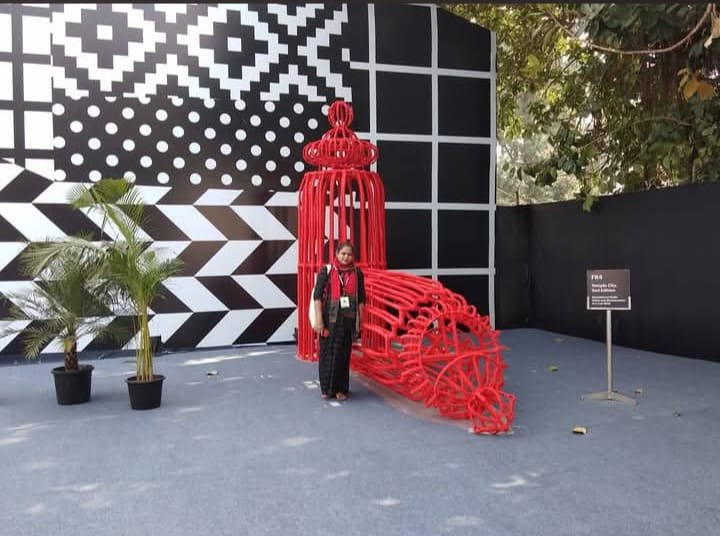
The significance of material becomes even more obvious outside painting.
Sculpture depends upon physical substance.
Installation can use objects, surfaces, space, and architectural surroundings.
Photography can transform material environments into visual records.
Public art can incorporate the physical character of walls and shared spaces.
Majhi’s multidisciplinary practice therefore provides multiple opportunities to explore material in different forms.
The Wall as Material
Public art introduces another interesting dimension.
A wall is not simply a blank surface.
It belongs to a building or neighbourhood.
It has a physical history and exists within a social environment.
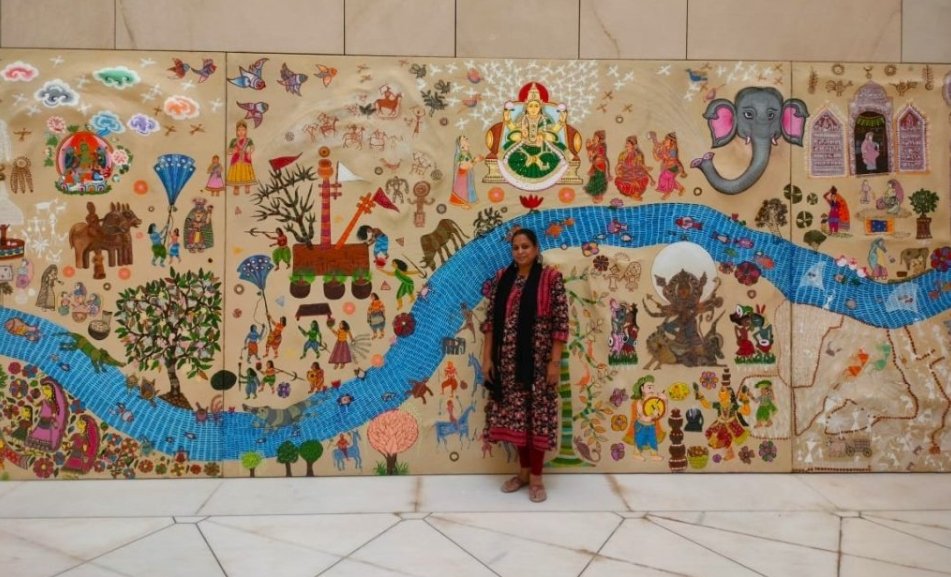
When Majhi creates or contributes to public murals, the wall itself becomes part of the artwork’s context.
The artwork therefore interacts with architecture, community, movement, and memory.
Materials and Public Memory
A public artwork can become associated with the identity of a place.
People may remember a neighbourhood partly through its visual features.
A mural can become one of those features.
Over time, residents may connect the artwork with particular journeys, events, celebrations, or periods of their lives.
Material and place consequently interact with collective memory.
The Human Hand
Natural pigments and traditional materials can also emphasise the role of the artist’s hand.
Modern industrial materials are often designed for consistency.
Natural materials can be less predictable.
Variations in texture, density, colour, and application may become part of the visual character of the work.
This can give the artwork a sense of physical process.
The viewer is reminded that the work was made through interaction between human skill and material behaviour.
Material as Cultural Vocabulary
When materials are associated with traditional or community practices, they can function as a kind of cultural vocabulary.
Their meanings may not be immediately visible to every viewer.
Understanding them requires context.
This is where Majhi’s engagement with communities and traditional visual practices becomes significant.
The material can be understood not simply as a technical choice but as part of a larger cultural conversation.
The Contemporary Relevance of Natural Materials
The use of natural pigments also has relevance in contemporary discussions about sustainability and environmental awareness.
Modern art has access to an enormous range of industrial materials.
Returning attention to natural materials can encourage questions about where artistic resources come from and how they are produced.
For Majhi, however, natural materials are not simply a contemporary environmental trend.
They are connected with cultural knowledge, landscape, artistic practice, and experience.
That deeper context gives the material greater significance.
Art as a Relationship With the Environment
Majhi’s work encourages viewers to think about art as a relationship with the environment.
The environment can provide subjects.
It can provide materials.
It can influence cultural practices.
It can shape communities.
It can influence movement and livelihood.
It can become part of memory.
Art can bring these relationships into visibility.
Material and Cultural Continuity
Cultural continuity does not require exact repetition of older practices.
Knowledge can survive through transformation.
A traditional material can appear in a contemporary artwork.
A regional motif can enter a new composition.
A community experience can influence a new public project.
In this sense, material becomes one way of carrying knowledge forward.
The Broader Meaning of Making
At its heart, artistic practice involves making.
Making means transforming something.
An artist transforms experience into ideas, ideas into forms, and materials into artworks.
Majhi’s practice makes this process particularly visible because her work crosses different media and engages with natural and cultural materials.
The act of making becomes a connection between observation and expression.
Conclusion
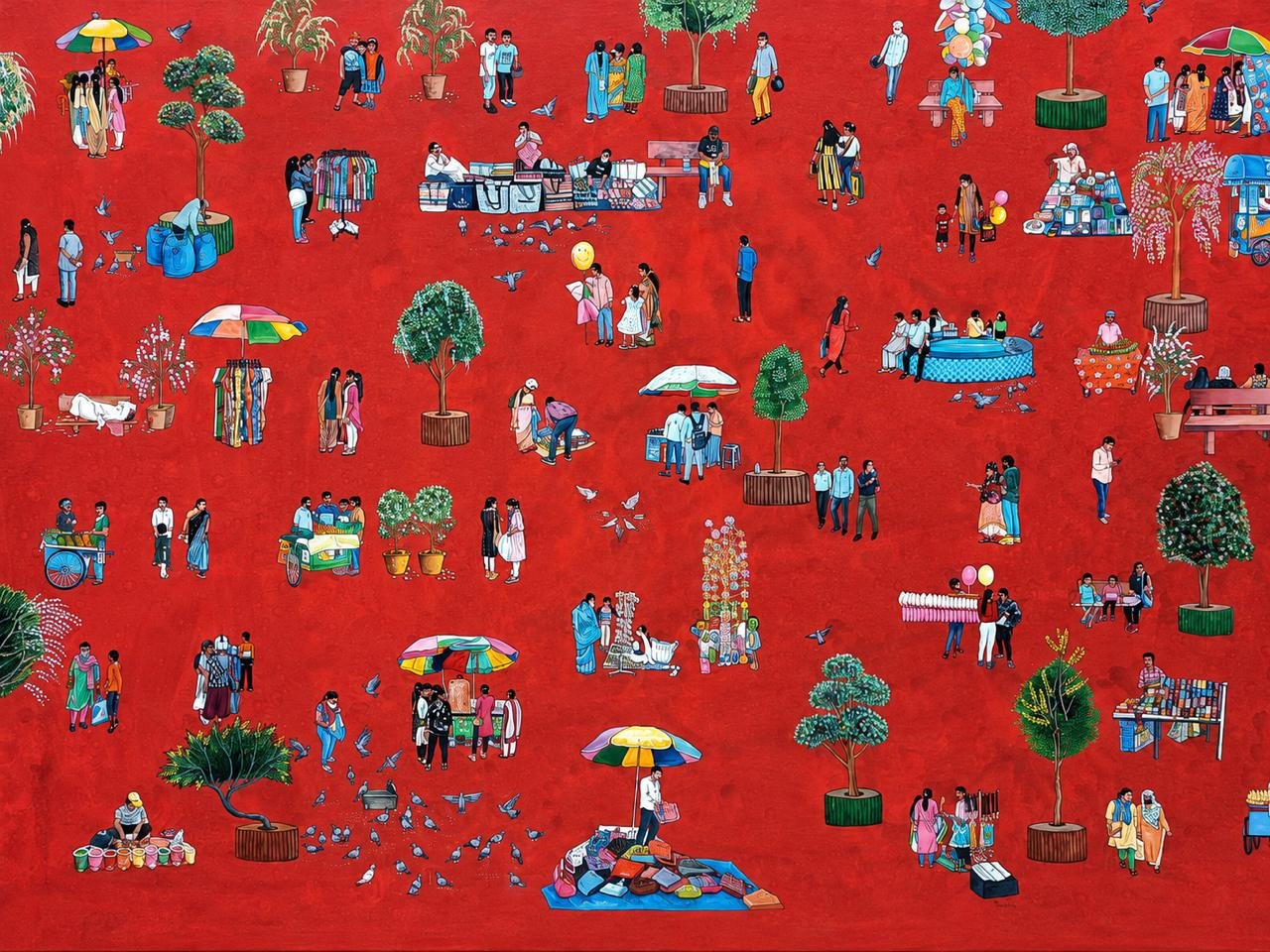
Satyabhama Majhi’s approach to material demonstrates how the physical substance of an artwork can carry cultural and environmental meaning.
Natural pigments such as chalk stone, charcoal, turmeric, geru soil, and brown stone are more than sources of colour. They can connect artistic practice with the earth, traditional knowledge, and the landscapes from which experiences emerge.
Her engagement with Niyamgiri and the Dongaria Kondh community adds another layer to this relationship, demonstrating how place, culture, material, and memory can intersect.
Across painting, sculpture, installation, photography, mixed media, and public art, Majhi continues to explore different ways of transforming experience into visual form.
Her work reminds us that an artwork does not communicate only through what it depicts.
It can also communicate through what it is made from.
A colour can carry the memory of soil. A form can recall a mountain. A wall can become part of a neighbourhood’s identity. A material can connect contemporary expression with traditional knowledge.
Through this understanding, Satyabhama Majhi’s practice presents material not as something secondary to artistic meaning, but as one of the ways meaning is created, preserved, and carried into the present.